Building a luxury custom home in Parker, Colorado, begins with a question that rarely has a simple answer: What will it cost to build?
In today’s high-end residential market, that question is no longer answered with a fixed number. Instead, it depends on a layered combination of design complexity, site conditions, engineering requirements, and the level of personalization built into every square foot of the home. This is why understanding the luxury home construction cost in Parker requires a deeper look at the decisions behind the design.
At Jackson Design Build, we approach luxury construction as a fully integrated process where architecture, engineering, and budgeting evolve together from the very beginning. In Parker’s growing luxury housing market, where larger lots, elevation changes, and custom estate development are common, no two homes follow the same construction path.
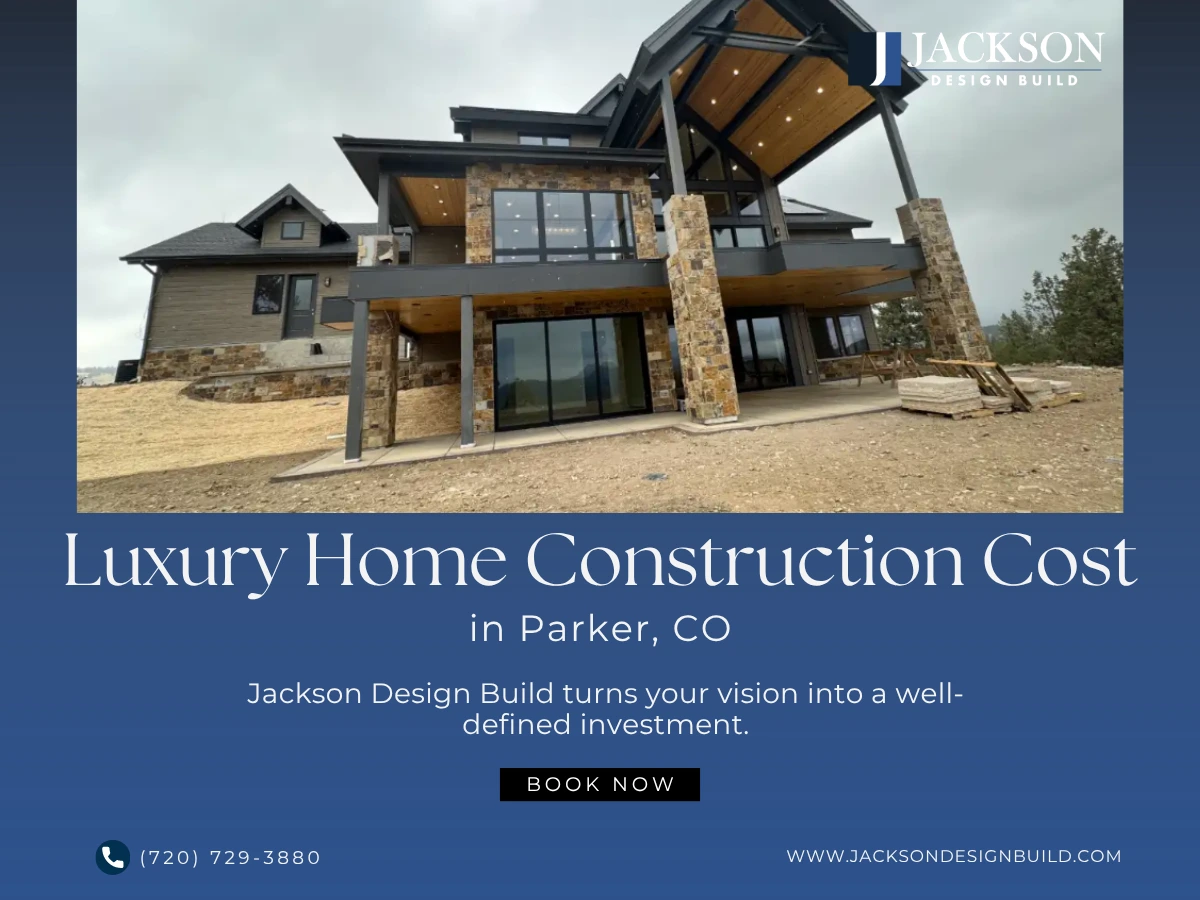
A residence with expansive glass walls, vaulted ceilings, and structural steel spans will require a completely different investment framework than a similarly sized home with simpler geometry and standard finishes.
This is why luxury home construction in Parker is best understood not as a price-per-square-foot equation, but as a system of design decisions that directly shape cost, performance, and long-term value.
How Design Decisions Drive Luxury Home Construction Cost in Parker
How does design style impact the construction budget?
A custom home is essentially a one-of-a-kind prototype. The complexity of that design plays a major role in shaping the overall investment.
- Structural Spans and Steel: Modern luxury often demands massive, open-concept spaces with no visible support columns. Achieving this requires complex steel headers and custom engineering that far exceeds the requirements of a standard build.
- Volume and Ceiling Heights: Higher ceilings increase the scale of framing, drywall, and HVAC requirements. Larger volumes also affect long-term energy performance and system sizing.
- The “Curtain Wall” Effect: The 2026 trend for floor-to-ceiling glass systems, often 12 feet or taller, requires specialized structural reinforcement to manage the weight and wind-load of the glass.
Site-Specific Engineering: The “Invisible” Infrastructure
Why is the land the most unpredictable factor in construction?
The land often determines the investment before the first brick is laid.
Topographical Challenges: Sloped terrain or hillsides offer the best views but require extensive retaining structures and stepped foundations. These are “invisible” costs which are very vital for the home’s integrity.
- Low-Impact Development (LID): 2026 environmental regulations often mandate advanced stormwater management, such as bio-retention basins and permeable paving.
- Utility Infrastructure: Bringing high-capacity power and fiber-optic lines to a secluded estate adds a layer of logistical investment that varies based on the property’s location.
These foundational elements play a significant role in shaping the average cost of luxury homes, particularly in areas like Parker, Colorado where lot conditions vary.
High-Performance Building Envelopes
Why is the “Building Envelope” a core investment in 2026?
The luxury market has shifted its focus from ornamentation to performance. A home’s “envelope”, its windows, doors, and insulation, is the most important factor in long-term comfort and acoustic privacy.
- Fenestration Quality: High-end builds utilize triple-pane, thermally broken aluminum or steel window systems. These units act as a barrier against both temperature and noise, a critical feature for estate-level privacy.
- Acoustic Mitigation: Advanced framing techniques and insulation strategies allow for sound control between spaces, improving livability.
- Passive House Standards: Many homeowners are now opting for “Net-Zero Ready” envelopes, which require precision sealing and Energy Recovery Ventilator (ERV) systems to maintain medical-grade air quality.
These features are increasingly influencing the new luxury home price range, as performance becomes a defining factor of modern luxury homes.
Technology: The Move Toward “Invisible Ecosystems”
What technology adds the most value to a 2026 custom build?
In 2026, luxury homes are defined not by visible gadgets, but by seamlessly integrated systems that operate in the background of daily life.
Rather than focusing on standalone devices, modern custom homes are designed with a structured infrastructure that supports whole-home connectivity, automation, and long-term adaptability. Technology planning must be incorporated early in the design phase to ensure systems can be integrated efficiently without impacting the architectural vision.
- Human-Centric Lighting:
Lighting can be designed to adapt throughout the day, enhancing comfort and supporting natural daily rhythms. - Smart Electrical Systems:
Electrical infrastructure can be planned to support energy monitoring and future upgrades, including renewable energy integration. - Embedded Audio:
Audio systems can be integrated into walls and ceilings to provide high-quality sound while maintaining a clean and uncluttered aesthetic.
The “Soft Cost” Framework: Design and Strategy
What are the non-construction drivers of a luxury budget?
A significant portion of a custom build occurs “off-site.” These “Soft Costs” are what ensure the project doesn’t suffer from “Design Drift.”
- Architectural & Interior Design: Crafting a cohesive vision that accounts for “view corridors” and furniture layouts before construction begins.
- Permitting and Environmental Studies: In 2026, luxury properties often require specialized soil reports, drainage plans, and architectural review board (ARB) approvals.
- The Design-Build Advantage: By integrating the builder into the design phase, you create a seamless alignment between architectural vision and construction feasibility, ensuring that every detail is both structurally sound and financially well-planned.
This level of planning contributes to a clearer understanding of the average cost of luxury homes, helping homeowners make informed decisions before construction begins.
Customization as a Long-Term Asset
Why is a fully custom home a superior investment?
Customization allows homeowners to design spaces that remain functional and relevant over time.
- Future-Proofing: Designing for “Aging in Place” or “Adaptive Reuse” (e.g., an office that can become a guest suite) ensures the home remains functional for decades.
- Market Differentiation: A home with a unique architectural pedigree and high-performance systems holds its value better than “cookie-cutter” luxury homes in the same neighborhood.
As customization increases, it directly impacts the new luxury home price range, reflecting the level of detail and personalization involved.
Why the Design-Build Model Controls Value
One of the most important factors in a successful luxury project is alignment. When design and construction are closely coordinated from the beginning, it allows homeowners to move forward with confidence, knowing that their vision is supported by a clear and well-managed investment strategy.
At Jackson Design Build, our integrated model provides:
- Concurrent Cost Planning:
Financial considerations are evaluated alongside design decisions to maintain alignment throughout the project. - Single Point of Responsibility:
One team oversees both design and construction, simplifying communication and coordination. - Efficient Execution:
Early material selection and planning help streamline construction and reduce unexpected adjustments during the build process.
Your Vision, Our Precision
Luxury home building is not a transaction; it is the realization of a personal legacy. Every layout decision, material selection, and structural choice contributes to a singular outcome.
At Jackson Design Build, we don’t believe in templates. We believe in intention. By recognizing how deeply personalization influences every stage of design and construction, we help you navigate the full scope of planning with clarity and confidence.
If you are planning a custom home and want a clear understanding of your luxury home construction cost, our team is here to guide you through every phase of the process. Contact Jackson Design Build today to schedule an architectural feasibility study.
FAQ: Navigating Your Custom Build Investment
Does a larger home always cost more per square foot?
Not necessarily. Luxury costs are driven by “density.” A 5,000 sq. ft. home with extreme architectural detail and high-end tech can have a higher investment profile than a 10,000 sq. ft. home with simpler finishes.
What is the “hidden” cost of a luxury build?
Landscape and “Hardscape” integration. A luxury home is incomplete without its environment. Infinity-edge pools, outdoor kitchens, and architectural lighting can represent a significant portion of the total project scope.
How do I ensure my vision stays within my target investment?
The key is Selection Finality. Finalizing every tile, light fixture, and floor plank during the design phase allows your builder to secure pricing and avoid the “market fluctuations” that can occur during a 12-month build cycle.